


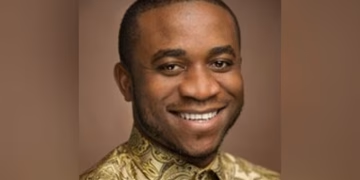





–Momodu mocks as opposition rifts deepen
–Ex-SGF Babachir withdraws support in major blow

–Labour Party crisis complicates 2027 calculations
By Eshiorameh Sebastian and James Adamu in Abuja
Erstwhile Labour Party presidential candidate, Peter Obi’s gamble on the opposition coalition appears to be unravelling as cracks widen within the African Democratic Congress (ADC), with key allies distancing themselves and the Labour Party slipping further from his grasp.
The former Anambra State governor, whose 2023 campaign galvanised Nigeria’s youth vote, now faces a political crossroads as his path to the 2027 election grows increasingly murky.
Obi, who joined the ADC-led coalition following a crisis in the Labour Party, has expressed frustration over the lack of cohesion among opposition leaders. In a video shared on Monday by an ally of former vice president Atiku Abubakar, Obi was seen addressing supporters in Port Harcourt, acknowledging the challenges while reaffirming his commitment to systemic change.
“So, which party am I going to contest in? As you know because of the problem they have, some of us who are leaders in the opposition have presently adopted ADC but I can tell you before the election more will join. More people will come to us. Because the opposition needs to come together.
“We have adopted ADC for 2027. We are still battling to take over Labour because that is the right thing to do,” he said.
However, he distanced himself from any power struggle, stating, “I am not desperate to be president of Nigeria, but I am desperate to see Nigeria change.
“We are not coming together to wrestle power, if it is to wrestle power, count Peter Obi out of it”, Obi said.
The former Anambra governor also proposed electoral reforms to curb party-switching after elections, a practice that has plagued Nigerian politics. “We will create a situation where nobody can leave his party after an election. If you want to change party, do it before the election. After the election, you must stay there. If you vacate, they replace you with another person,” he asserted.
Despite his public optimism, Obi’s political fortunes appear uncertain. His attempt to legitimise an interim faction within the Labour Party, led by Senator Nenadi Usman, has been met with resistance, as the Independent National Electoral Commission (INEC) remains silent over who is the authentic national chairman of the party and with Julius Abure’s name still on the commission’s portal.
This stalemate has weakened Obi’s influence, leaving him reliant on the ADC, where his prospects appear far from assured.
Veteran journalist Dele Momodu, a staunch ally of former Vice President Atiku Abubakar, shared Obi’s Port Harcourt speech with the caption, “PETER OBI BLOWS HOT,” a move widely interpreted as mockery.
Momodu has repeatedly dismissed Obi’s presidential ambitions, arguing that the ADC’s ticket should be zoned to the North to maximise electoral gains.
Momodu argued that Obi doesn’t possess the clout to win the 2027 election, reflecting deepening divisions within the opposition.
Further complicating Obi’s position is the apparent withdrawal of support from key allies. Babachir Lawal, a former Secretary to the Government of the Federation and once a vocal backer of Obi, appeared to distance himself in a recent interview on Channels TV’s Politics Today. “Things have changed. The parameters in choosing our candidate have changed too,” Lawal stated, signalling a possible realignment with another cadidate suspected to be Atiku.
Obi’s proposal for a single four-year term, with power subsequently shifting to the North, has also failed to gain traction. Atiku Abubakar and former Transportation Minister, Rotimi Amaechi, both eyeing the presidency, have shown little enthusiasm for the arrangement.
Amaechi, in particular, has insisted on a competitive primary, declaring during a recent X (formerly Twitter) chat. He maintained that anyone who claims to be popular should prove their popularity at the primary.
Ahmed Baba-Datti, Obi’s running mate in 2023, has raised concerns about the fairness of such a contest. In a recent interview, he alleged that wealthy politicians like Atiku and Amaechi could manipulate the process with financial influence, citing the contentious 2019 PDP primary in Port Harcourt as a precedent.
“What kind of primary election will Atiku and Amaechi conduct? Datti warned.
The ADC’s leadership has further dampened Obi’s hopes by insisting on an open primary process. Senator David Mark, the party’s national chairman, emphasised that no candidate would be favoured. The party’s position is that all aspiring for its presidential ticket must go through the primary election process. This is to set a standard and tell Nigerians that we will lead by example, Mark had said.
Political analysts argue that Obi faces an uphill battle in securing the ADC ticket, given the entrenched influence of figures like Atiku and Amaechi. His only viable alternative may be a return to the Labour Party, where he would need to reconcile with the Abure-led faction, a prospect fraught with uncertainty.
A return to the Labour Party would require humiliating concessions to Abure’s faction, while staying in the ADC risks becoming a footnote in someone else’s ambition.


Discussion about this post