




Nigeria exported an average of 45.8 per cent of its utilised gas in the first two months of 2026, even as domestic supply to power plants declined sharply, worsening the country’s persistent electricity shortages.
An analysis of data from the Nigerian Upstream Petroleum Regulatory Commission (NUPRC) reveals a sustained export bias in gas allocation during January and February, despite the existence of a regulatory framework designed to prioritise local consumption.

According to the data, total gas production fell from 233,961.47 million standard cubic feet (MMSCF) in January to 212,615.22 MMSCF in February, a 9.1 per cent drop. However, while overall output declined, the share of gas destined for foreign markets remained high.
In January, exports stood at 97,896.41 MMSCF, accounting for 45.3 per cent of total utilised gas. In February, export volumes were 91,740.87 MMSCF, representing an even higher 46.3 per cent of utilised volumes. Combined, Nigeria exported 189,637.28 MMSCF within the two-month period.
Conversely, domestic gas supply recorded a significant decline over the same period. Local sales dropped from 62,944.93 MMSCF in January to 52,300.45 MMSCF in February, a decrease of 16.9 per cent. As a proportion of utilised gas, domestic supply fell from 29.1 per cent to 26.4 per cent, indicating reduced availability for local consumption, including power generation.
The data also showed that substantial volumes of gas were consumed in field operations, with 55,503.14 MMSCF used in January and 54,357.34 MMSCF in February. This accounted for 25.7 per cent and 27.4 per cent of utilised gas respectively, further tightening supply to local end-users.
Regulatory Gaps and Commercial Realities
The Domestic Gas Delivery Obligation (DGDO), enforced by the NUPRC under the Petroleum Industry Act (PIA) 2021, requires every gas producer to prioritise domestic supply before exporting gas. The framework is designed to guarantee energy security by ring-fencing gas for critical sectors, including power generation companies and gas-based industries.
However, Minister of Power, Adebayo Adelabu, recently attributed the prioritisation of exports to the lucrative nature of foreign sales, the low government-regulated price of gas for the power sector, and the non-payment of existing debts owed to gas companies by the federal government.
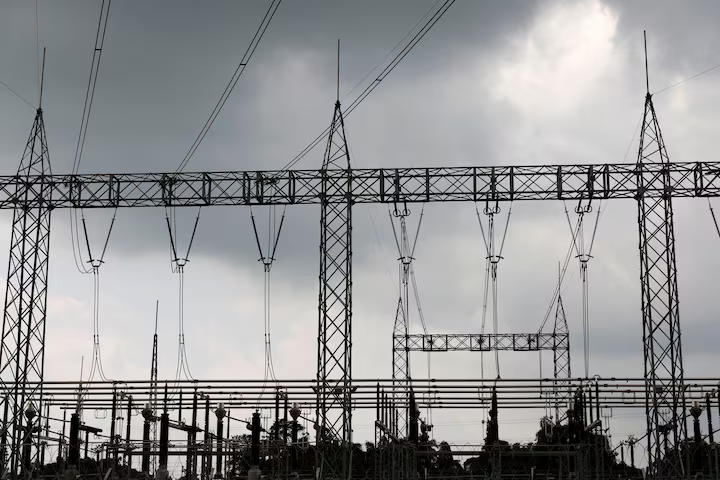
The structural imbalance has had severe implications for Nigeria’s power sector. Over the past two months, the country has experienced persistent electricity shortages, largely attributed to inadequate gas supply to thermal power plants, which account for over 75 per cent of installed generation capacity.
With domestic gas supply falling and its share of utilisation dropping to just over a quarter, power generation companies have faced increasing difficulty securing adequate feedstock, resulting in reduced output and grid instability.
Losses and Operational Efficiencies
While the data showed some improvements in operational efficiency, system losses remained significant. Gas flaring declined from 17,166.08 MMSCF in January, representing 7.34 per cent of total production, to 14,085.55 MMSCF or 6.62 per cent in February, a 17.9 per cent reduction.
Gas shrinkage—volumes lost during processing and transportation—also dropped sharply from 450.91 MMSCF in January to 131.00 MMSCF in February, suggesting improved efficiency in handling and transmission.
Nevertheless, industry observers note that the imbalances in Nigeria’s gas-to-power challenges are not solely a function of production shortfalls, but also of allocation priorities, infrastructure limitations, and commercial arrangements that favour export markets.
While Nigeria’s installed generation capacity exceeds 13 gigawatts on paper, the country typically transmits and distributes less than 5 gigawatts in practice, meaning more than half of potential supply is stranded at any given time.
The NUPRC had previously announced that upstream sector deliveries to meet the domestic gas obligation stood at 77 per cent as of July 2025. However, the latest data suggests that compliance with the DGDO has not translated into sufficient or reliable supply for the domestic market, as structural and commercial realities continue to incentivise producers to prioritise export sales.


Discussion about this post