




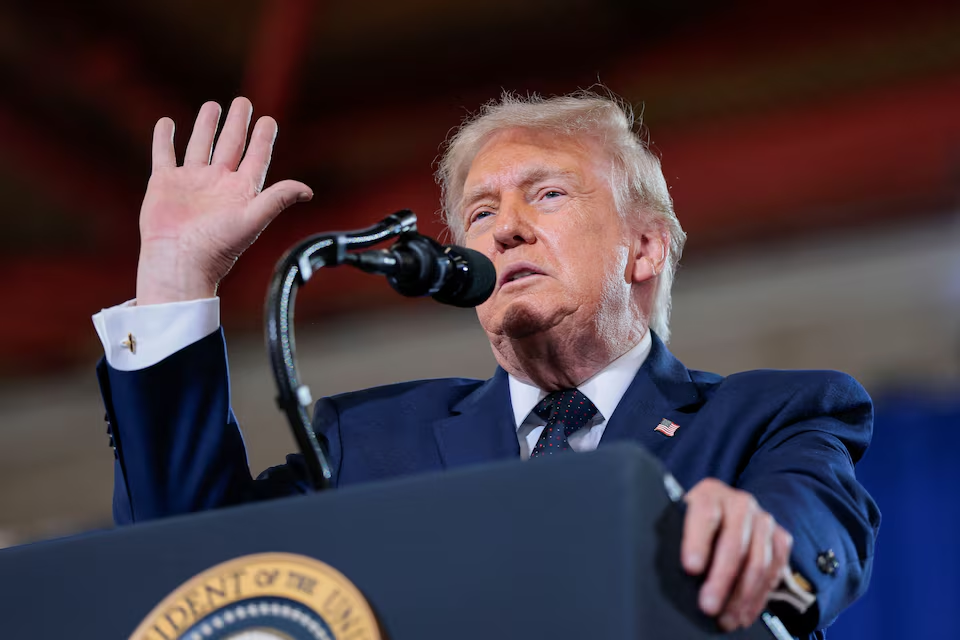
President Donald Trump announced Saturday that the United States and Iran have largely negotiated a sweeping peace agreement, which he said would include the reopening of the strategic Strait of Hormuz, following frantic back-channel mediation efforts led by Pakistan .
Speaking from the Oval Office, Trump said he had held a “very good call” with leaders from Saudi Arabia, the UAE, Qatar, Pakistan, Turkey, Egypt, Jordan, and Bahrain. The US President described the emerging deal as a “Memorandum of Understanding pertaining to PEACE,” noting that the agreement is “subject to finalization” between the U.S., Iran, and the other countries listed .

He confirmed a separate call with Israeli Prime Minister Benjamin Netanyahu, which he said “went very well,” though he did not elaborate on the details of that conversation .
According to Trump, the “final aspects and details of the Deal are currently being discussed” and will be “announced shortly.” Among the deal’s key provisions, he specified that the Strait of Hormuz—a critical chokepoint for global oil shipments—”will be opened” .
The President’s announcement caps months of intense indirect negotiations, with Pakistan’s military leadership acting as the primary intermediary between Washington and Tehran. Field Marshal Syed Asim Munir, the Chief of the Pakistani Army, has shuttled between the two capitals to “fine-tune” the text of what is being described as a 14-point memorandum .
However, reports from the region indicate that significant hurdles remain, and the mood in Tehran is one of cautious skepticism.
Nuclear standoff and uranium stockpiles
One of the primary sticking points remains Iran’s nuclear program. Trump has been adamant that Tehran must not retain its stockpile of highly enriched uranium.
The President has stated that the U.S. must take possession of the material, declaring, “We will get it. We don’t need it, we don’t want it. We’ll probably destroy it after we get it, but we’re not going to let them have it” .
According to reports from the International Atomic Energy Agency (IAEA), Iran still possesses roughly 440 kg of uranium enriched to 60 percent—material that is theoretically just a short technical step away from weapons-grade fuel .
Iranian officials, however, continue to insist that their nuclear program is for peaceful purposes.
Speaker of the Iranian Parliament Mohammad-Bagher Ghalibaf has warned that Tehran “will not compromise on the rights of the Iranian nation,” and Foreign Ministry spokesman Esmail Baghaei has described the differences between the two sides as “so deep and extensive” that no one should expect a quick fix .
The battle for the Strait of Hormuz
The Strait of Hormuz is the central piece of the puzzle. Before the conflict erupted in late February, nearly one-fifth of the world’s oil passed through the strait daily. Iran has effectively blockaded the waterway in retaliation for U.S.-led strikes, reducing traffic from a normal 125-140 ships per day to just 31 in the last 24 hours .
The current deadlock has triggered what the International Energy Agency calls the world’s “worst energy shock,” threatening global fuel prices as summer demand peaks .
Tehran has two major demands regarding the strait that are complicating the talks. First, Iran is seeking official recognition of its sovereignty or control over the waterway. Second, Tehran intends to charge tolls or fees for ships transiting the strait, a move Washington views as “completely illegal” .
U.S. Secretary of State Marco Rubio has firmly rejected this. “It’s a threat to the world if they were trying to do that,” Rubio said earlier this week. Trump echoed that sentiment, demanding the strait be “open” and “free” .
The Institute for the Study of War (ISW) warns that simply “opening” the strait is not the same as returning to the status quo. Analysts note that Iran could maintain de facto control by threatening to attack ships that do not comply with Iranian demands, creating a situation where the strait is technically open, but navigation remains hostage to Tehran’s whims .
Economic sanctions and frozen assets
The economic dimension is equally fraught. The U.S. blockade of Iranian ports is currently costing Tehran an estimated $500 million per day in lost revenue. Iran’s primary export terminal at Kharg Island is reportedly at nearly 80 percent capacity, threatening a catastrophic shutdown of its oil fields if storage is maxed out .
In exchange for reopening the strait and curbing its nuclear program, Tehran is demanding a steep price: a sweeping relief from international sanctions, the release of more than $100 billion in frozen assets held abroad, and compensation for war damages .
Mediation and the Israel factor
Pakistan has emerged as the unlikely broker of this deal. Interior Minister Mohsin Naqvi has visited Tehran multiple times this week carrying messages from the U.S., while Field Marshal Munir held late-night meetings with Iranian leadership to bridge the gaps .
However, the presence of Israel in the background adds another layer of complexity. While Trump says his call with Netanyahu went “very well,” Israeli officials are reportedly skeptical of the U.S. approach. An anonymous official told the Associated Press that Israel is angry with the negotiations and is on “maximum alert,” concerned that a deal with the U.S. may leave Israel exposed or legitimize Iran’s nuclear infrastructure .
A ’50/50′ chance
Despite the optimism in Trump’s Truth Social post, the President himself struck a realistic tone about the outcome. He described the chance of reaching an agreement as a “solid 50/50,” warning that the alternative is a military escalation of devastating proportions.
“I think one of two things will happen: either I hit them harder than they have ever been hit, or we are going to sign a deal that is good,” Trump said .
Iran’s lead negotiator described the situation in a phrase that has gone viral in Persian media: “The agreement is both very far and very close”.


Discussion about this post