

























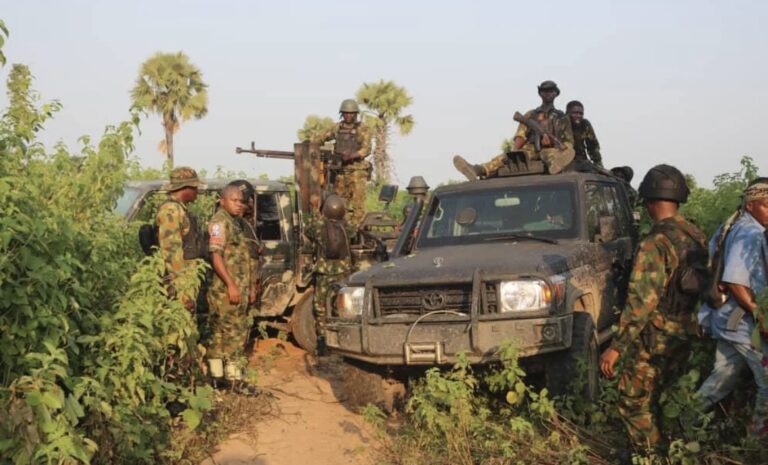
The Defence Headquarters has announced that troops of Operation Hadin Kai have foiled a series of coordinated and drone-assisted terrorist attacks in Nigeria’s North-East, eliminating several fighters including senior commanders in what military authorities describe as a decisive escalation in ongoing counter-insurgency operations.
The disclosure, made in Abuja by the Director of Defence Media Operations, Maj.-Gen. Michael Onoja, reflects a week of intensified military engagements across multiple theatres between March 13 and March 19, during which ground forces, supported by coordinated air operations, repelled a major assault on Mallam Fatori in Abadam Local Government Area of Borno State.

According to the military, the attack described as complex and involving the use of drone surveillance or support was met with sustained resistance by troops, leading to the killing of dozens of insurgents, including high-ranking field commanders. Subsequent exploitation operations in the aftermath of the encounter resulted in the recovery of 74 bodies believed to be those of terrorists, alongside a significant cache of weapons that included 38 AK-47 rifles, three PKT machine guns and a rocket-propelled grenade tube.
Military authorities said the scale of the engagement underscores both the evolving tactics of insurgent groups operating in the region and the heightened operational readiness of Nigerian forces tasked with countering them. The North-East, long plagued by insurgency linked to extremist groups, has witnessed a shift in recent years toward more coordinated attacks, including attempts to overrun military formations and communities.
“Troops also thwarted multiple infiltration attempts across Bama, Gujba and Kaga local government areas, while key logistics suppliers and informants were arrested. Coordinated air and ground operations also repelled attacks in Baga, Damboa, Buratai and Njimtilo, degrading ISWAP capabilities,” Onoja said, pointing to sustained pressure on terrorist networks through simultaneous offensives across strategic locations.
The operations reflect a broader military strategy aimed at dismantling not only the combat elements of insurgent groups but also their supply chains and intelligence networks. The arrest of suspected collaborators and logistics suppliers, according to defence officials, is central to weakening the operational capacity of these groups and preventing future attacks.
Beyond the North-East, the military reported significant gains across other regions of the country, highlighting the nationwide scope of ongoing security operations. In the North-West, troops under Operation Fansan Yamma conducted raids in Zamfara, Katsina, Kaduna and Kebbi states, targeting banditry and kidnapping networks that have continued to destabilise communities.
Onoja disclosed that troops neutralised armed elements in Shinkafi Local Government Area of Zamfara State, recovering weapons and motorcycles commonly used in criminal operations. In Katsina, security forces rescued four kidnapped victims, while in Kaduna they successfully foiled an attempted abduction of a cleric, forcing the attackers to retreat under pressure.
The military also intercepted a female courier in Kano State transporting 884 rounds of ammunition, an incident that officials say highlights the increasingly complex logistics structures supporting criminal groups. The use of couriers, including women, reflects a tactical adaptation by such networks to evade detection and sustain their operations.
In the North-Central region, troops engaged in Operations Savannah Shield and Enduring Peace carried out arrests of suspected terrorists and ammunition couriers in Kwara, Plateau and Nasarawa states. Rescue missions conducted in Plateau and Benue led to the safe recovery of abducted individuals, while enforcement actions in and around the Federal Capital Territory disrupted illegal mining activities linked to criminal financing.
“These operations demonstrate the armed forces’ resolve to deny criminal elements freedom of action and ensure the safety of citizens,” Onoja said, reiterating the military’s commitment to maintaining pressure across all fronts.
The Niger-Delta region also witnessed intensified operations targeting oil theft and related criminal activities, a persistent challenge that has significant economic implications for Nigeria. Troops of Operation Delta Safe uncovered multiple illegal bunkering sites and intercepted large quantities of stolen petroleum products during coordinated raids in Delta, Bayelsa and Rivers states.
According to the military, several suspects involved in kidnapping, illegal refining and drug trafficking were arrested, while over 3,000 litres of illegally refined petroleum products were seized. Vehicles and boats used in transporting stolen fuel were also intercepted, as security forces moved to dismantle networks involved in the illicit trade.
In the South-East, troops under Operation Udo Ka conducted clearance operations in Imo State, neutralising suspected terrorists and recovering improvised explosive devices. Additional operations in Ebonyi and Cross River states led to the arrest of suspected cultists and the recovery of weapons, further highlighting the spread of security challenges across different parts of the country.
The Defence Headquarters noted that the cumulative successes recorded within the reporting period demonstrate a sustained effort to restore stability, protect critical infrastructure and reinforce law and order nationwide. The operations also reflect a shift toward more intelligence-driven and coordinated engagements, combining ground assaults with air support to counter increasingly sophisticated threats.
As security forces continue to adapt to evolving tactics, including the reported use of drones by insurgents, military authorities insist that ongoing operations are designed not only to neutralise immediate threats but also to create long-term conditions for peace and stability across affected regions.











Discussion about this post