






By Spear News Nigeria
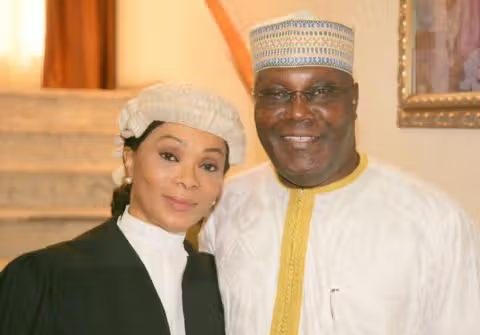
Fresh details from an International Chamber of Commerce (ICC) arbitration award have revealed that Leno Adesanya, promoter of Sunrise Power and Transmission Company Limited, transferred $500,000 to Jennifer Douglas, former wife of ex-Vice-President Atiku Abubakar, in January 2003.

The said transaction came just months before Sunrise was allegedly awarded the Mambilla hydropower contract.
According to the final award by a three-member ICC tribunal in the dispute between Sunrise and the Federal Republic of Nigeria, the payment was made on January 30, 2003, through China Castle Investments Limited, an offshore firm controlled by Adesanya.
Adesanya told the tribunal the money was part of a foreign-exchange deal carried out for Atiku, claiming he ran a bureau de change through Moneyline Ventures Limited and that the dollars were purchased with naira on Atiku’s behalf.
In his fourth witness statement, he stated: “I confirm that I made a transfer of $500,000 to the Abubakars through my company China Castle Investments Ltd in early 2003.” Under cross-examination, he also admitted sending the money to Douglas.
However, the tribunal found his explanation unconvincing. Adesanya failed to provide documents showing the naira payment, the exchange rate used, instructions from Atiku or his aides, or any correspondence proving the transaction’s commercial purpose.
He claimed the discussions were oral and that after more than two decades, he no longer had access to any written records.
Neither Atiku nor Douglas testified in the arbitration. The tribunal noted that Sunrise and Adesanya did not submit any witness statement from either of them to support the foreign-exchange claim.
Adesanya said he tried to get Atiku to testify, but the former vice-president was reluctant to be dragged into a case involving former President Olusegun Obasanjo, citing his position as an opposition politician.
He initially claimed Atiku’s lawyers had confirmed the payment was a forex transaction. But under cross-examination, he said the explanation came from “Dr Ndukwe,” described as Atiku’s medical doctor, with later confirmation through lawyers. When pressed on whether Atiku himself confirmed it, Adesanya called it his “logical assumption.”
The tribunal said Adesanya produced no correspondence, phone records, or evidence of contact with Atiku’s counsel, Ndukwe, or the former vice-president’s aides.
Adesanya claimed he could not get Douglas to testify because she and Atiku had gone through a bitter divorce and she had cut him off for opposing the separation and supporting Atiku and another wife.
“She would not even pick my call,” he said.
The tribunal noted this contradicted his earlier witness statement, where he described Douglas as a close friend and his first girlfriend in high school.
The award also referenced a 2010 US Senate Permanent Subcommittee on Investigations report on offshore transfers into Douglas’s US accounts. The report said that when banks questioned the payments, she insisted the funds came from her husband and claimed little knowledge of the offshore companies that sent them.
The tribunal concluded that the lack of corroborating evidence and the inconsistencies in Adesanya’s testimony meant it could not accept that the $500,000 was a forex transfer for Atiku.
It also found he failed to prove Moneyline held a bureau de change licence at the time. Even if he had, the tribunal said, the money was transferred by China Castle, not Moneyline. Adesanya admitted under cross-examination that China Castle was not licensed for forex transactions and that such business was outside its stated corporate purposes.
The tribunal examined the payment against the backdrop of Mambilla negotiations, which began nearly two years earlier.
On September 12, 2001, Sunrise and North China Power Engineering Company met National Electric Power Authority officials to express interest in the project. Sunrise was incorporated in Nigeria on October 9, 2001, with Adesanya, his wife, and Lenoil Holdings Limited as initial shareholders.
Six days later, North China Power Engineering Company and Lenoil Holdings met to discuss power projects, including Mambilla.
On October 18, Sunrise wrote separately to Obasanjo and Atiku, informing them of its interest, with its Chinese partner, in developing the hydropower project. Atiku and his team met Sunrise and the Chinese company on November 13. Minutes cited by the tribunal show the then vice-president said the project would cost about $6 billion, while the companies reaffirmed their interest.
Sunrise and the Chinese firm submitted a proposal to the technical committee of the federal ministry of power and steel on December 12, 2001. Sunrise also sought a waiver of the mandatory $500,000 processing fee required by NEPA.
In January 2002, Obasanjo and Olusegun Agagu, then minister of power and steel, invited Sunrise to preliminary discussions. On March 1, Agagu told the company Mambilla would be privately financed and that the federal government was considering a minority equity stake of no more than 25 percent.
Atiku later led a federal government delegation to China in July 2002, including Aliyu, then minister of state for power and steel, and Adesanya. During the trip, Nigerian officials and Chinese companies signed a memorandum of understanding covering several power projects, including the first phase of Mambilla, then estimated at $4.5 billion and 2,600 megawatts.
In August 2002, Agagu gave Sunrise the proposed principal terms and conditions for Mambilla, which the company returned the following month. Agagu later left to contest the Ondo governorship election and was replaced by Olu Agunloye.
On December 9, 2002, the ministry invited Sunrise to a January 15, 2003 meeting to discuss and agree on the principal terms and conditions for executing the project.
Sunrise presented its tender to a multi-agency technical committee on January 15 or 16. About two weeks later, on January 30, China Castle transferred $500,000 to Douglas’s Citibank account.
Technical Committee Recommended Sunrise
On March 12, 2003, the technical committee issued its report. It said seven international construction companies expressed interest, but only four — Tafag Nigeria Limited, Lemna International, Sunrise, and Propel Consortium — submitted detailed proposals.
After assessing the proposals, the committee recommended Sunrise for the 3,960MW project based on cost effectiveness, capacity to execute the work, and economic implications. It proposed further negotiations and said Sunrise offered a tariff of 2.1 US cents per kilowatt-hour under a 40-year build-operate-transfer arrangement.
On April 7, Agunloye wrote to Obasanjo seeking approval to issue Sunrise a letter of comfort, begin negotiations on the concession and financing, determine how the government’s proposed 25 percent equity would be funded, and appoint technical consultants.
Obasanjo wrote on the memorandum on April 9 that he had no objection but directed the minister to present the matter to the Federal Executive Council for deliberation.
Agunloye submitted a memorandum to the council on May 15. The proposal came up at the council’s meeting of May 21, but its consideration and the extent of any approval became a central dispute in the arbitration.
Obasanjo’s position was that the council did not approve the contract and that he ordered the memorandum withdrawn. Sunrise relied on a letter issued by Agunloye on May 22, 2003, as evidence it had been awarded the project on a build-operate-transfer basis. That disputed letter became the foundation of Sunrise’s multibillion-dollar arbitration claim against Nigeria.
Tribunal Examined Atiku’s Influence
Sunrise and Adesanya argued that Atiku lacked the political power to influence the purported May 2003 award. The tribunal found that contention implausible.
It noted that Atiku was directly involved in Mambilla discussions from at least 2001, hosted a meeting with Sunrise and its Chinese partner, and led the Nigerian delegation to China in 2002.
The tribunal also relied on a February 2003 US diplomatic cable describing Adesanya as an “Atiku insider” and an associate of the vice-president. The cable recounted a late-January conversation in which Adesanya reportedly told US officials that Atiku had extracted major concessions from Obasanjo during negotiations over their re-election ticket and would become the “de facto head of government” if they won.
Adesanya did not deny the substance of his comments, though he said the cable was only an extract from a longer conversation. He said his point was that Atiku should not be discounted because of his political strength in northern Nigeria.
The tribunal concluded that Atiku possessed considerable power and influence in the federal government during the first half of 2003.
However, Atiku was not a party to the arbitration, did not testify, and was not shown to have personally directed the transfer to Douglas’s account, based on the materials reviewed.
Sunrise Loses, Faces Costs
Sunrise commenced its first arbitration against Nigeria in 2017, seeking about $2.35 billion for an alleged breach of the 2003 agreement. The parties later negotiated a settlement under which Nigeria was to pay the company $200 million.
A further dispute arose over the settlement, with Sunrise seeking another $200 million as a default payment, bringing its principal demand in the second arbitration to $400 million before interest.
In its final award, the ICC tribunal dismissed Sunrise’s claims and rejected its request for an order compelling Nigeria to pay the $200 million settlement sum and the additional $200 million default amount.
It also held that Adesanya was bound by the arbitration provisions in the settlement agreement and its addendum, and that it had jurisdiction over Nigeria’s counterclaim against him and Sunrise.
The tribunal ordered Sunrise and Adesanya to reimburse Nigeria for 75 percent of its legal fees and expenses. Nigeria’s recoverable costs were put at $11.82 million, of which $2.5 million was to come from funds held in escrow by the ICC. The balance of about $9.32 million is payable by Sunrise and Adesanya, with interest..


Discussion about this post